A tour of LookWAYup
Thesaurus and Extended Information
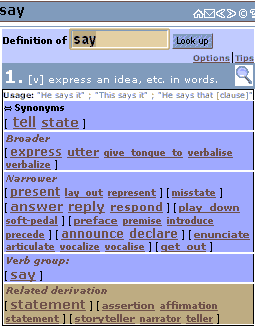 Next to each definition you will see the link "More..." This links to
the thesaurus, where you will find synonyms and related terms, including more
general or more specific terms. There are about 40 possible types of
relations between related terms. Other terms can be related by a common
derivation, one can be made up of the other, and so on. And the
relationship is not just to a word but to a particular sense of that word.
Next to each definition you will see the link "More..." This links to
the thesaurus, where you will find synonyms and related terms, including more
general or more specific terms. There are about 40 possible types of
relations between related terms. Other terms can be related by a common
derivation, one can be made up of the other, and so on. And the
relationship is not just to a word but to a particular sense of that word.
The thesaurus page also provides usage
examples and other linguistic information. For instance in the full
version, verbs are not just marked as transitive or intransitive. A full list
of usage is given - can the subject be a person or a thing? Is the object of the
verb direct
or indirect? and so forth.
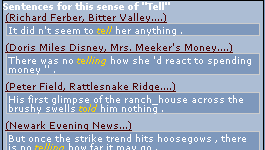 The more detailed information
for the sense of the term also includes a link to example sentences. These
are sentences that use this word in
this particular sense. These examples are taken from classic books, newspaper
stories, and other published sources. This is unique; you won't find this
in any other inexpensive online dictionary
The more detailed information
for the sense of the term also includes a link to example sentences. These
are sentences that use this word in
this particular sense. These examples are taken from classic books, newspaper
stories, and other published sources. This is unique; you won't find this
in any other inexpensive online dictionary
How common is your first or last name? Look it up - LookWAYup has
thousands of names ranked by frequency (in the U.S.)
Remember how LookWAYup can be either installed in the browser sidebar or be
used as a regular
web page? The Grow/Shrink page feature lets you switch from one to the other.
You can either have the easier-to-read full browser page, or the compact and
convenient sidebar dictionary at your side while you browse.
Thank you
Thank you for taking the LookWAYup tour. It has only scratched the
surface of what can be done with LookWAYup. But remember that at its core,
LookWAYup goes far beyond matching a string of end-to-end letters to spit out a
bunch of text - it deals with meanings and the specific sense of the word that
you are looking at. We hope you'll find it interesting and useful.
<< Previous <<
[ Close this window ]